We started UNOCU because we were tired of watching good startups live and die at the mercy of other people's capital.
Companies with real products, real users, and real revenue would shut down because they couldn't close a funding round in time. Not because the business was bad. Because the funding model is broken. We decided to build something that gives founders a way out.
This post is the thesis behind everything we're building. It is not a market update. It is not a product pitch. It is what we believe to be true about where startups are headed, and why we think the ones that figure out crypto treasury management will be the ones that survive.
The Funding Model Is Broken
The cost to build a technology company has collapsed. A Mac mini, a few cloud services, and open-source AI models can now do what used to require a floor of engineers and millions in monthly burn. Cloud infrastructure scales on demand. AI handles tasks that once required entire teams. A small, sharp team can ship a real product with a modest budget.
Yet the funding model has not caught up. Startups still raise every 18 months. They still give up equity in every round. They still live on someone else's timeline, governed by someone else's expectations about when to grow, when to hire, and when to pivot.
If a round doesn't close, the company dies. It doesn't matter how good the product is, how loyal the users are, or how strong the revenue is. If the wire doesn't land, the lights go off.
This cycle rewards fundraising skill over building skill. It puts founders in a position of permanent dependency. You are always 12 to 18 months away from needing permission to keep going. That is not a business. That is a hostage situation with a cap table.
We believe there is a better path. Not one that rejects outside capital entirely, but one that makes it optional. A path where founders build a financial engine inside their own company that generates enough yield to cover operating expenses, extend runway indefinitely, and raise only when it makes strategic sense, not because they are running out of time.
Startups Already Run Crypto Treasuries — They Just Don't Know It
If you run a startup in 2026, you are probably already touching crypto in some form. You just might not be calling it that.
•Customers pay invoices in USDC or other stable coins.
•Team members receive part of their compensation in tokens or on-chain equity-like instruments.
•Idle cash sits in tokenized dollar positions, or the company holds some BTC or ETH exposure.
•Revenue from SaaS, services, or products gets partially allocated to staked crypto positions to earn yield.
The problem is that most of this happens ad hoc. Different wallets. Different exchanges. A DeFi app here, a custodian there. No single source of truth. No coherent view of risk. No way to tell your board, with confidence, where the money is and what it is doing.
Startups are effectively running a crypto treasury without a crypto treasury system. They have the pieces but not the picture. The assets exist, the yield opportunities exist, and the infrastructure exists. What is missing is the layer that ties it all together and makes it useful.
The Feedback Loop
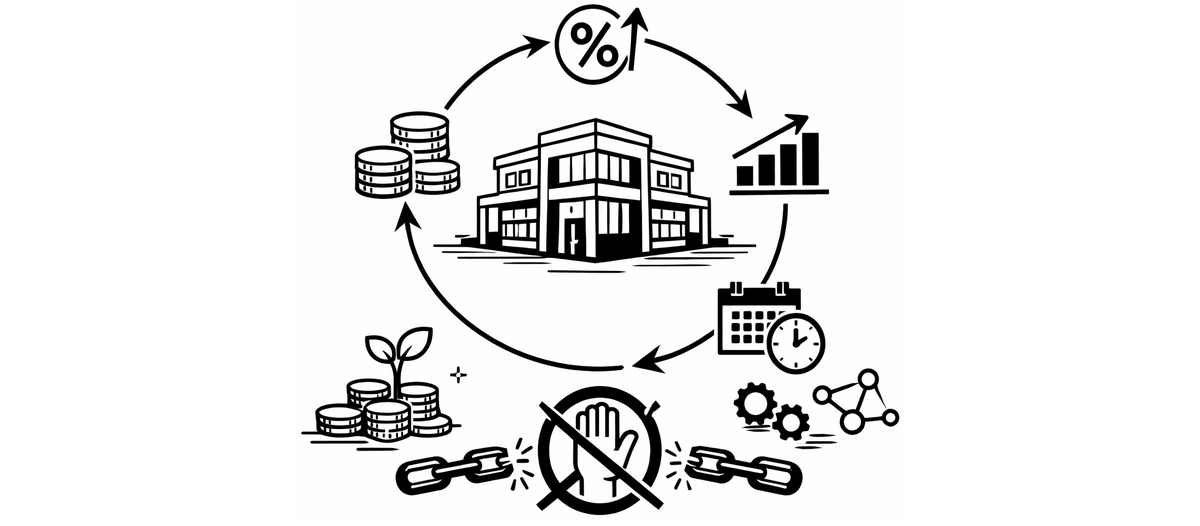
This is the core concept behind our thesis. We call it the crypto treasury feedback loop, and it works like this:
•Build your treasury. Allocate a portion of revenue to crypto positions. Not all of it. A disciplined share that you can afford to lock up.
•Earn yield. Stake those assets. Earn compound interest. Depending on the asset and the strategy, you are looking at 3 to 6 percent APY.
•Allocate wisely. Use the profits from those positions to buy more yield-generating assets. Compound.
•Extend your runway. As yield income grows, it covers a larger share of your operating expenses. Every month, the treasury carries more of the weight.
•Buy more time to build. Every month the treasury covers more of your costs, you need less outside capital. Your dependency on external funding shrinks.
The goal is self-sufficiency. A startup that generates enough yield to cover its expenses does not need to raise. It can still choose to bring in outside capital for strategic acceleration, but it does so from a position of strength, not desperation.
This is not a theoretical model. It is basic compounding math applied to a company's balance sheet. The same principle that makes retirement accounts work over decades can work for a startup over quarters, because the yield is real, the math is real, and the cost to operate a lean startup has never been lower.
What Changes When You Have a Treasury
When your treasury generates meaningful yield, everything about how you operate changes.
•You stop living on someone else's timeline. No more "we have 14 months of runway and need to start raising in 6." Your runway is a function of your own yield, not a countdown clock set by your last funding round.
•You stop giving up equity to survive. Founders keep more of what they build. Dilution becomes a choice, not a necessity.
•You stop optimizing for fundraising optics. Instead of shaping your roadmap around what investors want to hear, you build what your users actually need.
•You have optionality. Want to raise a strategic round? Fine. But you negotiate from strength, not from the back foot of a dwindling bank balance.
We track this shift with a metric we call the self-sufficiency score. It is built into UNOCU's Nurture module, and it answers one question: what percentage of your operating expenses are covered by crypto yield? When that number hits 100 percent, you are free. You no longer need anyone's permission to keep building.
That is the threshold we want every startup to reach. Not because outside capital is bad, but because needing it to survive is a vulnerability that good companies should not have.
This Is Infrastructure, Not Speculation
We need to be clear about what we are advocating, because the word "crypto" carries baggage.
We are not talking about speculation. We are not talking about betting the company's cash on the next token launch or chasing triple-digit yields on unaudited protocols. That is gambling, and we have no interest in it.
What we are talking about is treating crypto as a treasury tool. That means:
•Disciplined allocation based on risk tolerance and liquidity needs.
•Staking for yield with a clear understanding of lock-up periods and counterparty risk.
•Tracking performance against benchmarks, the same way you would track any investment.
•Integrating with accounting systems so your books are always accurate and audit-ready.
•Having a dashboard that shows your board exactly where funds sit, what risks exist, and how yields are performing.
It means treating your crypto balance sheet with the same seriousness as your bank account. Because it is your bank account. It is where a growing share of your operating capital lives, and it deserves the same rigor.
The winners in this space will not be the loudest yield farms or the flashiest DeFi protocols. They will be the teams that treat crypto as part of a coherent treasury strategy, with controls, reporting, and accountability built in from day one.
The World We're Building For
We see a future that looks different from the one most of the startup ecosystem assumes.
In the world we are building for, startups use outside capital because they choose to, not because they are underwater. A small, sharp team builds on affordable hardware, with AI and cloud infrastructure, and uses their own treasury to fund growth. Founders spend less time selling a story to investors and more time compounding a real asset base that they actually own.
In this world, every meaningful startup is a crypto treasury company. Not because crypto is trendy, but because it is the most efficient way to turn effort and profit into a self-sustaining financial engine. A business with a product, a community, and a growing on-chain balance sheet that supports it.
We are not naive about the risks. Crypto markets are volatile. Yields fluctuate. Regulatory landscapes shift. But the fundamental infrastructure is here, and it is getting more mature every quarter. Stablecoins are reliable. Staking yields are real. On-chain accounting tools are improving. The pieces are in place for founders who are willing to think differently about how they fund their companies.
The question is not whether this will happen. It is whether you will be early enough to benefit from it.
UNOCU is the tool we wish we'd had when we were building our first companies. It is a way to turn effort and profit into an enduring treasury, so you do not have to raise, beg, or borrow just to keep going.
We built five products to cover the full treasury lifecycle: Umbrella for portfolio oversight, Nurture for growth tracking, Obtain for acquisition, Compound for yield management, and Utilize for deployment. Treasury Copilot sits across all of them, providing AI-powered answers grounded in your actual data.
We do not take custody of your assets. Your keys, your crypto. UNOCU reads data and makes it useful.
Free to start at unocu.com.
Disclaimer: This content is for informational purposes only and does not constitute financial advice. Crypto assets are volatile and carry risk. Always conduct your own research before making investment decisions.